Shop For Parts By Year
Select The Year Of Your Vehicle Below
Motor City BMW Parts Master Catalog for OEM Components and VIN Lookup
Sourcing replacement hardware for your BMW requires an uncompromised level of technical precision to sustain the brand's legendary driving dynamics, advanced electrical networks, and structural resale value. Whether you are executing a routine engine oil service on a twin-turbo inline-six, overhauling the brake assembly on an M Performance crossover, or seeking direct-fit interior climate microfilters, utilizing exact-spec equipment is vital.
The digital storefront at Motor City BMW Parts links directly with active factory warehouse master catalogs, providing enthusiasts, independent service technicians, and fleet owners throughout Michigan with real-time access to genuine BMW parts mapped explicitly to factory specifications.
Operating a high-technology luxury vehicle in a demanding climate alters the lifespan of high-wear mechanical systems and delicate sensory modules. Implementing a proactive vehicle care strategy using factory-authorized components shields your powertrain and adaptive chassis networks from premature failure, keeping your vehicle aligned with its original safety thresholds and premium engineering standards up to the current 2026 model line limits.
Two High-Precision Search Channels: Keyword Processing and VIN Validation
To simplify your digital parts search and eliminate procurement guesswork, our master landing portal features a distinct dual-track processing system. Depending on the vehicle information or reference documentation you have available, you can instantly route your inventory lookup through two dedicated processing nodes positioned directly on your screen:
- Look Up BMW Part Numbers (Left Processing Input): Positioned on the left side of our lookup block, this entry portal is engineered for high-efficiency alphanumeric searches. If you have a part number extracted from a stamped factory casing, an insurance collision estimate, or a previous workshop invoice, input it here to check local Michigan warehouse availability and real-time wholesale pricing variants instantly.
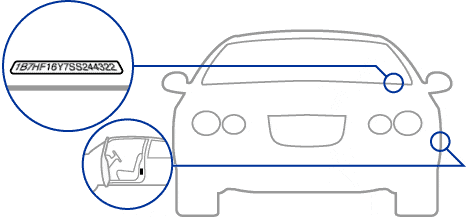
- Search By VIN (Right Validation Input): Housed on the right side of our main interface block, this vehicle identification number system delivers absolute fitment verification. Entering your unique 17-character sequence commands the database to analyze your vehicle's specific assembly date, factory package options, and localized engine configurations, automatically filtering out incompatible parts while showing you the exact direct-fit solutions built for your frame.
Decoding the 11-Digit Alphanumeric BMW Component Syntax
BMW utilizes a highly structured, logical 11-digit indexing format to identify every fastener, electronic module, and friction surface across its global model index. Typically grouped into a sequence like XX-XX-X-XXX-XXX, understanding the core mechanical architecture of this part syntax helps you trace structural component updates directly from the labels on your old hardware:
- The Main Functional Group (First 2 Digits): This initial numerical pair identifies the primary automotive system or core category family. For instance, code 11 explicitly designates internal engine components, code 31 isolates front axle suspension assemblies, and code 34 marks the braking control framework.
- The Functional Subgroup (Next 2 Digits): Positioned immediately after the initial group, this pair refines the search down to a specific sub-assembly location. In the engine catalog, a combination like 11-12 isolates the cylinder head structure, while 34-11 pinpoints the front brake pads and ventilated rotors.
- The Core Component Identifier (Remaining 7 Digits): The final seven-character sequence designates the individual part shape, weight calibration, and precise build layout. If a component is modified due to factory design updates, material chemistry improvements, or supplier changes during the model generation, this final sequence updates to reflect the change.
This integrated parts syntax makes cross-referencing highly predictable. Whenever a component design is optimized by factory engineers to improve long-term thermal handling or resistance to mechanical stress, the original tracking sequence is superseded. Our intelligent lookup engine monitors these supersession chains automatically, ensuring that when you enter an older stamped code, you are instantly guided to the latest approved, factory-authorized design iteration.
How Harsh Michigan Climates and Road Conditions Accelerate Component Wear
Operating a premium vehicle in the Great Lakes region subjects structural systems to intense environmental stressors that accelerate wear on common service items. Sourcing high-durability replacement parts through Motor City BMW Parts directly addresses these localized midwestern operational challenges:
Severe winter driving patterns involve constant exposure to aggressive liquid road de-icers and rock salt compounds, which rapidly corrode exposed undercar components. This chemical exposure accelerates degradation on aluminum suspension control arm bushings, trailing link hardware, and wheel hub assemblies, while also causing microscopic pitting along the surface of exposed exhaust brackets and oxygen sensors.
Concurrently, freeze-thaw cycles create severe potholes that place immense physical shock loads on your suspension, necessitating timely replacements of struts, coil springs, and stabilizer links to maintain original handling profiles.
Furthermore, managing stopping power under heavy thermal loads requires pristine friction surfaces. High-performance models equipped with M Sport braking arrays rely on soft, highly responsive pad formulations to bring significant vehicle mass to a controlled halt.
Prolonged exposure to moisture and grit can cause premature rotor scoring, brake pad glazing, or electronic pad wear sensor corrosion. Sourcing genuine factory rotors and matched brake pads guarantees rapid heat dissipation, prevents dangerous pedal fade, and preserves complete compatibility with your Dynamic Stability Control (DSC) system computer loops.
The Necessity of VIN Sourcing and Eliminating Production Split Risks
BMW is well-known for implementing subtle engineering modifications mid-year on its global production lines without altering outward model styling, a process often tied to Life Cycle Impulse (LCI) generational updates. These running changes create hidden production breaks where two vehicles built in the same calendar year can require completely different front brake calipers, engine microfilters, internal alternator outputs, or electrical wiring pigtail connections based on their specific assembly month or plant location.
This catalog complexity is especially critical across your drivetrain configuration. For example, vehicles utilizing the intelligent xDrive all-wheel-drive system require strict, uniform tolerances across all four wheel hubs to prevent placing undue torsional strain on the central transfer case module.
Installing a non-compliant axle shaft or a slight variance in a wheel bearing speed ring can confuse active traction sensors, illuminating persistent dashboard diagnostic trouble codes and potentially leading to expensive secondary mechanical breakdowns. Utilizing our right-hand automated VIN search input entirely bypasses this risk, scanning official build sheet archives to guarantee full part compatibility on your very first installation attempt.